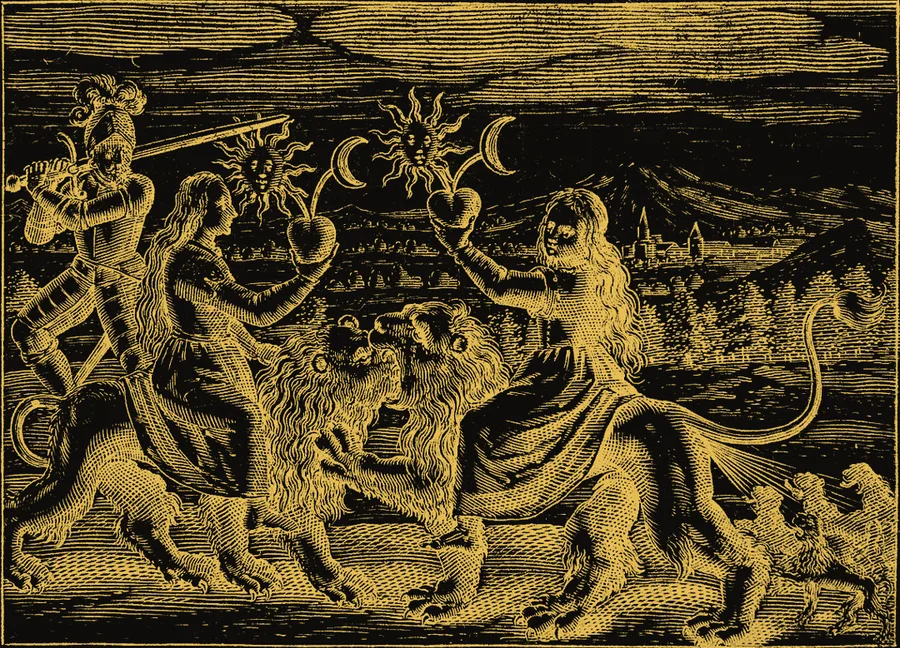
The Eleventh Key is about multiplication, how the finished Stone grows. Basil tells it as a parable: a knight named Orpheus and his wife have no children until a winged messenger, Phoebus, tells them to mix blood from each of them and keep it sealed until the Moon has changed eight times; then their children fill the world. In plain words: what has grown inside you starts to grow outward and reach other people.
What the engraving shows
Basil Valentine’s Eleventh Key, from the Musaeum Hermeticum. Photograph: Wellcome Collection, CC BY 4.0; colours added.
The engraving shows two women riding two lions face to face, each holding up a heart beneath the Sun and the Moon, while a knight in armour raises his sword behind them and lion cubs play at their feet.
What it teaches
The Eleventh Key: multiplication, told as a parable of the knight Orpheus and his wife. What has grown inside you starts to grow outward and reach other people.
What the alchemists meant
Multiplication meant increasing the strength and the quantity of the finished stone by dissolving and setting it again with more of its own kind, so that a little of it could change much more. What is multiplication in alchemy?
The Eleventh Key, in full
The eleventh Key to the Knowledge of the augmentation of our Stone, I will put before you in the form of a parable. There lived in the East a gilded knight, named Orpheus, who was possessed of immense wealth, and had everything that heart can wish. He had taken to wife his own sister, Euridice, who did not, however, bear him any children. This he regarded as the punishment of his sin in having wedded his own sister, and was instant in prayer to God both by day and by night, that the curse might be taken from him. One night, when he was buried in a deep sleep, there came to him a certain winged messenger, named Phoebus, who touched his feet, which were very hot, and said:
"Thou noble knight, since thou hast wandered through many cities and kingdoms, and suffered many things at sea, in battle, and in the lists, the heavenly Father has bidden me make known to thee the following means of obtaining thy prayer: Take blood from thy right side, and from the left side of thy spouse. For this blood is the heart's blood of your parents, and though it may seem to be of two kinds, yet, in reality, it is only one. Mix the two kinds of blood, and keep the mixture tightly enclosed in the globe of the seven wise Masters. There that which is generated will be nourished with its own flesh and blood, and will complete its course of development when the Moon has changed for the eighth time.
If thou repeat this process again and again, thou shalt see children's children, and the offspring of thy body shall fill the world." When Phoebus had thus spoken, he winged his flight heavenward. In the morning the knight arose and did the bidding of the celestial messenger, and God gave to him and to his wife many children, who inherited their father's glory, wealth, and knightly honours from generation to generation. If you are wise, my son, you will find the interpretation of my parable. If you do not understand it, ascribe the blame not to me, but to your own ignorance. I may not express myself more explicitly; indeed, I have revealed the matter in a more plain and straightforward manner than any of my predecessors. I have concealed nothing; and if you will but remove the veil of ignorance from your eyes, you will behold that which many have sought and few found.
Basil Valentine, The Twelve Keys (1599), in the English of the Hermetic Museum (1893).
In Lead to Gold
In Lead to Gold, the Eleventh Key’s engraving is the plate of Gate 11, Multiplication, in the Your gold part of the path. The whole of the Twelve Keys is in the app’s Library, with a note in plain words on every key.
Last updated October 25, 2026.
Lead to Gold: Shadow Work, on Google Play
The alchemists’ Great Work, made into ten quiet minutes a day: twelve gates, a private journal, and a line of wisdom from the old masters. Free to download, for Android.
What does Basil Valentine’s Tenth Key mean?: Basil Valentine’s Tenth Key (1599) explained: why the Stone must not be hurried, the Latin sayings of its engraving, and the full text in English.
What does Basil Valentine’s Twelfth Key mean?: Basil Valentine’s Twelfth Key (1599) explained: projection, the use of the finished Stone, the lion and the furnace, and the full text in English.
What is multiplication in alchemy?: Multiplication, stage 11 of the twelve stages of alchemy: it grows and reaches others. What the alchemists did, and what it means for you.
What are Basil Valentine’s Twelve Keys?: The Twelve Keys of Basil Valentine (1599): who he was, the twelve engravings, and what each key teaches about the Great Work, in plain words.