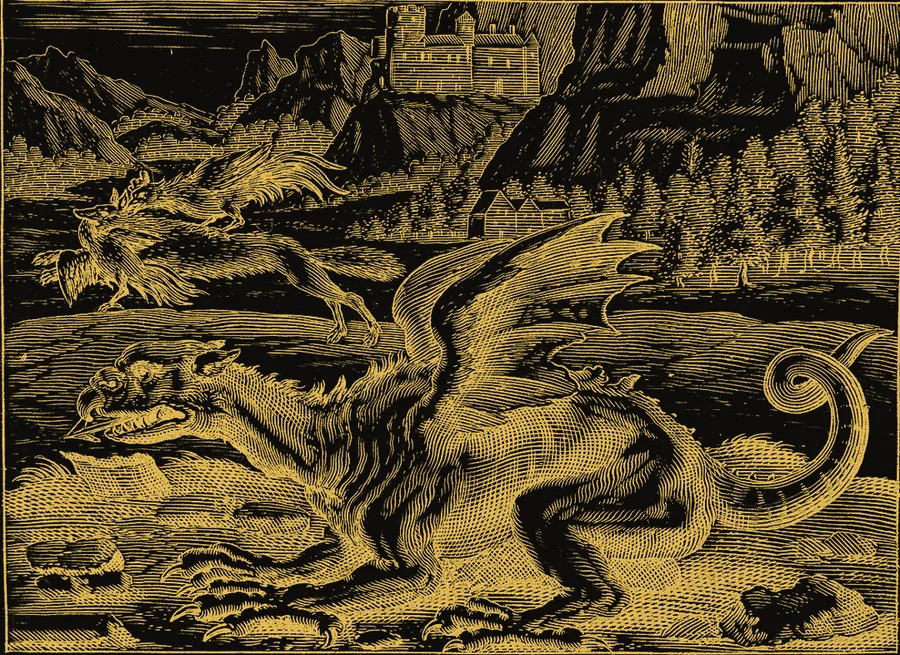
The Third Key is about the dragon: fire overcome by water, and then rising again to win. Basil says the fiery sulphur of the work must first be overcome by its water and must then triumph in its turn, and that when this is done you have before your eyes ‘the light of wisdom, which shines in the darkness, although it does not burn’.
What the engraving shows
Basil Valentine’s Third Key, from the Musaeum Hermeticum. Photograph: Wellcome Collection, CC BY 4.0; colours added.
The engraving shows a winged dragon in a mountain landscape below a castle, and behind it a cock swallowing a fox. That is the key’s last line: ‘then the Cock will swallow the Fox, and, having been drowned in the water, and quickened by the fire, will in its turn be swallowed by the Fox’.
What it teaches
The Third Key: the dragon. Fire is overcome by water, and then the fire rises again and wins. The light of wisdom “shines in the darkness, although it does not burn”.
The pelican and the rose
The key also gives two famous pictures of the finished tincture: the pelican, which ‘wounds its own breast’ to feed its young, and ‘the Rose of our Masters, of purple hue, called also the red blood of the Dragon’.
The Third Key, in full
By means of water fire may be extinguished, and utterly quenched. If much water be poured upon a little fire, the fire is overcome, and compelled to yield up the victory to the water. In the same way our fiery sulphur must be overcome by means of our prepared water. But, after the water has vanished, the fiery life of our sulphurous vapour must triumph, and again obtain the victory. But no such triumph can take place unless the King imparts great strength and potency to his water and tinges it with his own colour, that thereby he may be consumed and become invisible, and then again recover his visible form, with a diminution of his simple essence, and a development of his perfection.
A painter can set yellow upon white, and red or crimson upon yellow; for, though all these colours are present, yet the latter prevails on account of its greater intensity. When you have accomplished the same thing in our Art, you have before your eyes the light of wisdom, which shines in the darkness, although it does not burn. For our sulphur does not burn, but nevertheless its brilliancy is seen far and near. Nor does it colour anything until it has been prepared, and dyed with its own colour, which it then imparts to all weak and imperfect metals. This sulphur, however, cannot impart this colour until it have first by persevering labour been prevailed upon to abjure its original colour.
For the weaker does not overcome the stronger, but has to yield the victory to it. The gist of the whole matter lies in the fact that the small and weak cannot aid that which is itself small and weak, and a combustible substance cannot shield another substance from combustion. That which is to protect another substance against combustion must itself be safe from danger. The latter must be stronger than the former, that is to say, it must itself be essentially incombustible. He, then, who would prepare the incombustible sulphur of the Sages, must look for our sulphur in a substance in which it is incombustible, which can only be after its body has been absorbed by the salt sea, and again rejected by it.
Then it must be so exalted as to shine more brightly than all the stars of heaven, and in its essence it must have an abundance of blood, like the Pelican, which wounds its own breast, and, without any diminution of its strength, nourishes and rears up many young ones with its blood. This Tincture is the Rose of our Masters, of purple hue, called also the red blood of the Dragon, or the purple cloak many times folded with which the Queen of Salvation is covered, and by which all metals are regenerated in colour. Carefully preserve this splendid mantle, together with the astral salt which is joined to this sulphur, and screens it from harm.
Add to it a sufficient quantity of the volatility of the bird; then the Cock will swallow the Fox, and, having been drowned in the water, and quickened by the fire, will in its turn be swallowed by the Fox.
Basil Valentine, The Twelve Keys (1599), in the English of the Hermetic Museum (1893).
In Lead to Gold
In Lead to Gold, the Third Key’s engraving is the plate of Gate 3, Separation, in the Shadow work part of the path. The whole of the Twelve Keys is in the app’s Library, with a note in plain words on every key.
Last updated October 25, 2026.
Lead to Gold: Shadow Work, on Google Play
The alchemists’ Great Work, made into ten quiet minutes a day: twelve gates, a private journal, and a line of wisdom from the old masters. Free to download, for Android.
What does Basil Valentine’s Second Key mean?: Basil Valentine’s Second Key (1599) explained: Mercury between two swordsmen, the washing of the bride and bridegroom, and the full text in English.
What does Basil Valentine’s Fourth Key mean?: Basil Valentine’s Fourth Key (1599) explained: the skeleton on the coffin, why all flesh must return to earth and ashes, and the full text in English.
What is separation in alchemy?: Separation, stage 3 of the twelve stages of alchemy: keeping what is yours. What the alchemists did, and what it means for you.
What are Basil Valentine’s Twelve Keys?: The Twelve Keys of Basil Valentine (1599): who he was, the twelve engravings, and what each key teaches about the Great Work, in plain words.