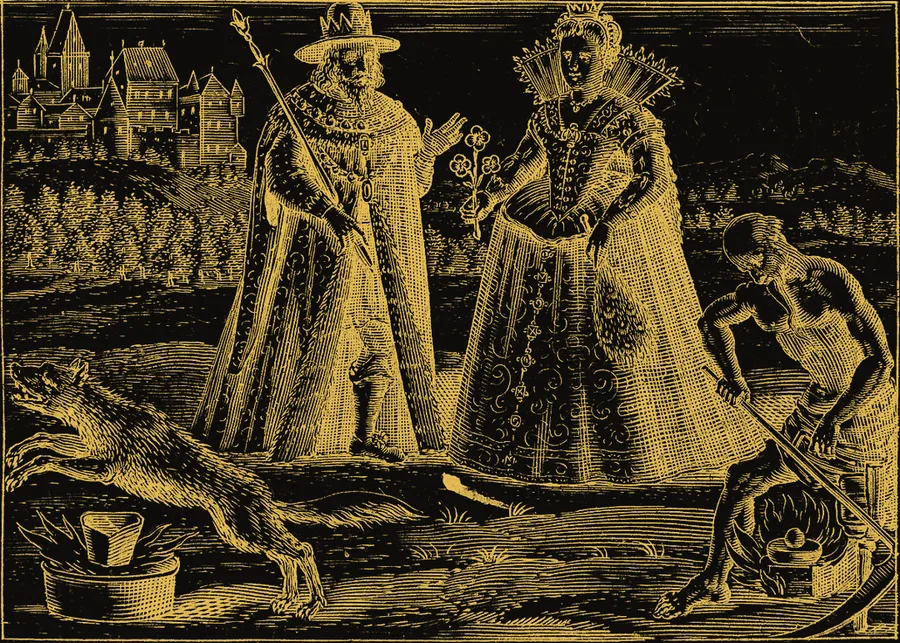
The Twelve Keys are Basil Valentine’s guide to the Great Work, printed in 1599 with twelve engravings. Each key is a riddle in words and a picture, from the grey wolf that devours the king in the First Key to the use of the finished work in the Twelfth. Basil says he was a Benedictine monk; nobody knows for sure who he was.
Who was Basil Valentine?
The books under his name say he was a Benedictine monk, but no record of such a monk has been found. They began to appear around 1600, published by Johann Thölde, and some historians suspect Thölde wrote them himself. Whoever he was, the Twelve Keys became one of the best-loved books of alchemy, for its engravings as much as its words.
The engravings
Basil Valentine’s First Key, from the Musaeum Hermeticum. Photograph: Wellcome Collection, CC BY 4.0; colours added.
Each key comes with an engraving, and the pictures are as much a part of the riddle as the words. The First Key shows the king and queen of the work, the grey wolf that devours the king, and Saturn at the fire. Each key’s own page below shows its engraving beside the full text.
The twelve keys, one by one
The First Key: purification. A grey wolf devours the king, and is then burned so the king comes out pure. Nothing impure is any use. In plain words: start by being honest about what is not really you.
The Second Key: the bath. Two swordsmen guard Mercury, and the bride and bridegroom must be washed and made bare. In plain words: let yourself be seen, and let the hard surface soften.
The Third Key: the dragon. Fire is overcome by water, and then the fire rises again and wins. The light of wisdom “shines in the darkness, although it does not burn”.
The Fourth Key: ashes. Everything from the earth must return to earth before it can rise again. “For where there was not first earth, there can be no resurrection.” Endings make room for new life.
The Fifth Key: the magnet. Like draws like, “with the invisible bonds of love”. The power of growth comes from the living spirit in things. If you understand this, Basil says, you are richer than the whole world.
The Sixth Key: the marriage. Opposites are joined, and everything depends on measure: too much seed and nothing ripens, too little and weeds take over. Give just measure, “neither too little nor too much”.
The Seventh Key: warmth. A moderate heat keeps life going; too much destroys it. In winter everything looks dead, but the warmth of summer returns. Keep your work in a sealed, protected place, and keep its fire gentle.
The Eighth Key: sowing and rising. A seed must rot in the earth before it grows; the farmer knows this without knowing why. The dark stage is not failure; it is how new life starts.
The Ninth Key: the colours. The work passes through black, grey, white, yellow and red. The planets march in procession: Charity, Faith, Hope and Courage each carry a banner. Every colour is a stage, and each one passes.
The Tenth Key: patience. “No fruit can grow from a flower that has been plucked before the time.” He who is in too great a hurry spoils what he has in hand.
The Eleventh Key: multiplication, told as a parable of the knight Orpheus and his wife. What has grown inside you starts to grow outward and reach other people.
The Twelfth Key: projection, the use of the finished work. Knowing is not enough; you have to use what you know. “For he that has knowledge and experience on his side, must carry off the victory.”
How to read them
The keys are written in riddles and pictures, and the inner meaning has been read in them for four hundred years. The English text most people know is in the Hermetic Museum of 1893.
In the old masters’ words
“Let your mind be like a firm Rock.” Basil Valentine, The Twelve Keys, 1599
In Lead to Gold
Every gate on the Path in Lead to Gold carries one of the Twelve Keys’ engravings (photographs: Wellcome Collection, CC BY 4.0), and the whole text is in the app’s Library with notes in plain words. The keys on the Path:
The alchemists’ Great Work, made into ten quiet minutes a day: twelve gates, a private journal, and a line of wisdom from the old masters. Free to download, for Android.
What does Basil Valentine’s First Key mean?: Basil Valentine’s First Key (1599) explained: the grey wolf that devours the king, what the engraving shows, and the full text of the key in English.
What are the stages of alchemy?: The stages of alchemy: nigredo, albedo, citrinitas and rubedo, and the twelve operations from Calcination to Projection, each explained in plain words.
What is the Golden Tractate of Hermes?: The Golden Tractate is a short alchemical book under the name of Hermes: a father teaching his son about the Stone, patience, and light out of darkness.