The Twelfth Key is about projection, the use of the finished work. Knowing is not enough, Basil says; you have to use it: ‘he that has knowledge and experience on his side, must carry off the victory’. Here he drops his riddles and sets out how the Stone was to be used: first joined with gold as a ferment, then one part of it to a thousand parts of molten metal.
What the engraving shows
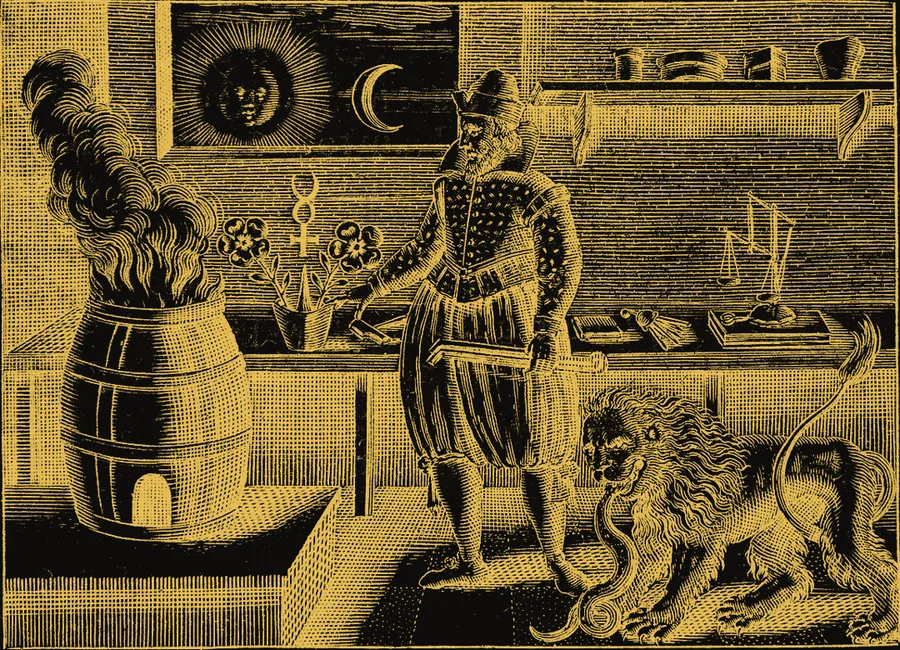
Basil Valentine’s Twelfth Key, from the Musaeum Hermeticum. Photograph: Wellcome Collection, CC BY 4.0; colours added.
The engraving shows an alchemist in his laboratory beside a barrel-shaped furnace pouring out smoke, with a lion devouring a serpent at his feet. The Sun, the Moon, flowers, a pair of scales and books fill the room around him.
What it teaches
The Twelfth Key: projection, the use of the finished work. Knowing is not enough; you have to use what you know. “For he that has knowledge and experience on his side, must carry off the victory.”
Was it ever done?
No such transmutation has ever been confirmed. In spiritual alchemy, projection means using what the work has made in you, in ordinary days. What is the philosopher’s stone?
The Twelfth Key, in full
If an athlete know not the use of his sword, he might as well be without it; and if another warrior that is skilled in the use of that weapon come against him, the first is like to fare badly. For he that has knowledge and experience on his side, must carry off the victory. In the same way, he that possesses this tincture, by the grace of Almighty God, and is unacquainted with its uses, might as well not have it at all. Therefore this twelfth and last Key must serve to open up to you the uses of this Stone. In dealing with this part of the Subject I will drop my parabolic and figurative style, and plainly set forth all that is to be known.
When the Medicine and Stone of all the Sages has been perfectly prepared out of the true virgin's milk, take one part of it to three parts of the best gold purged and refined with antimony, the gold being previously beaten into plates of the greatest possible thinness. Put the whole into a smelting pot and subject it to the action of a gentle fire for twelve hours, then let it be melted for three days and three nights more. For without the ferment of gold no one can compose the Stone or develop the tinging virtue. For the same is very subtle and penetrating if it be fermented and joined with a ferment like unto itself: then the prepared tincture has the power of entering into other bodies, and operating therein.
Take then one part of the prepared ferment for the tinging of a thousand parts of molten metal, and then you will learn in all faith and truth that it shall be changed into the only good and fixed gold. For one body takes possession of the other; even if it be unlike to it, nevertheless, through the strength and potency added to it, it is compelled to be assimilated to the same, since like derives origin from like. Whoever uses this as a medium shall find whither the vestibules of the palace lead, and there is nothing comparable to the subtlety thereof. He shall possess all in all, performing all things whatsoever which are possible under the sun.
O principle of the prime principle, consider the end! O end of the final end, consider the beginning! And be this medium commended unto your faithful care, wherein also God the Father, Son, and Holy Ghost, shall give unto you whatsoever you need both in soul and body.
Basil Valentine, The Twelve Keys (1599), in the English of the Hermetic Museum (1893).
In Lead to Gold
In Lead to Gold, the Twelfth Key’s engraving is the plate of Gate 12, Projection, in the Your gold part of the path. The whole of the Twelve Keys is in the app’s Library, with a note in plain words on every key.
Last updated October 25, 2026.
Lead to Gold: Shadow Work, on Google Play
The alchemists’ Great Work, made into ten quiet minutes a day: twelve gates, a private journal, and a line of wisdom from the old masters. Free to download, for Android.
What does Basil Valentine’s Eleventh Key mean?: Basil Valentine’s Eleventh Key (1599) explained: the parable of the knight Orpheus, how the Stone was said to multiply, and the full text in English.
What are Basil Valentine’s Twelve Keys?: The Twelve Keys of Basil Valentine (1599): who he was, the twelve engravings, and what each key teaches about the Great Work, in plain words.
What is projection in alchemy?: Projection, stage 12 of the twelve stages of alchemy: your gold, cast into the world. What the alchemists did, and what it means for you.