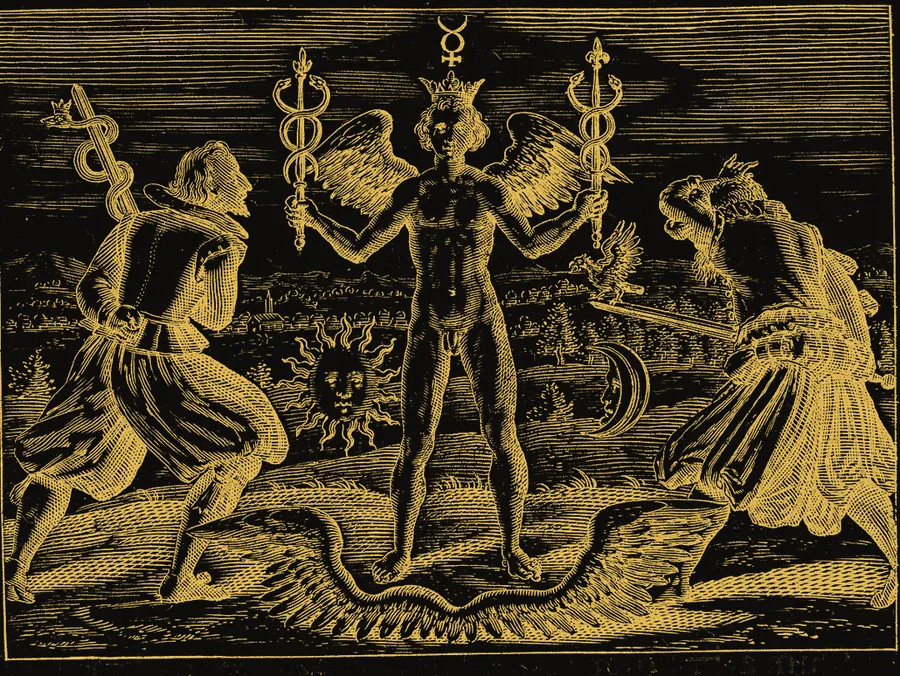
The Second Key is about the bath, the washing of the matter. Basil compares the king and queen of the work, Apollo and Diana, to a bride and bridegroom who are washed with many kinds of water and stripped of all their fine clothes before they are joined. The bath must be made of ‘two hostile kinds of matter, that purge and rectify each other by means of a continued struggle’.
What the engraving shows
Basil Valentine’s Second Key, from the Musaeum Hermeticum. Photograph: Wellcome Collection, CC BY 4.0; colours added.
In the engraving Mercury stands in the middle, winged and crowned with his own sign, with a snake-twined staff in each hand and a winged serpent under his feet. The Sun is on one side of him and the Moon on the other, and a swordsman stands on each side.
What it teaches
The Second Key: the bath. Two swordsmen guard Mercury, and the bride and bridegroom must be washed and made bare. In plain words: let yourself be seen, and let the hard surface soften.
The eagle and the dragon
The key ends with a second picture of the bath: the Eagle, set over the fire with ‘the icy Dragon that has long had its habitation upon the rocks’, until the heat melts the snow on the mountains into water for the bath.
The Second Key, in full
In the houses of the great are found various kinds of drink, of which scarcely two are exactly like each other in odour, colour, or taste. For they are prepared in a great variety of different ways. Nevertheless they are all drunk, and each is designed for its own special use. When the Sun gives out his rays, and sheds them abroad upon the clouds, it is commonly said that he is attracting water, and if he do it frequently, and thereby cause rain, it is called a fruitful year. If it be intended to build a palace, the services of many different craftsmen must be employed, and a great variety of materials is required.
Otherwise the palace would not be worthy the name. It is useless to use wood where stone is necessary. The daily ebb and flow of the sea, which are caused by the sympathetic influence of heavenly bodies, impart great wealth and blessing to the earth. For whenever the water comes rolling back, it brings a blessing with it. A bride, when she is to be brought forth to be married, is gloriously adorned in a great variety of precious garments, which, by enhancing her beauty, render her pleasant in the eyes of the bridegroom. But the rites of the bridal night she performs without any clothing but that which she was arrayed withal at the moment of her birth.
In the same way our bridal pair, Apollo and Diana, are arrayed in splendid attire, and their heads and bodies are washed with various kinds of water, some strong, some weak, but not one of them exactly like another, and each designed for its own special purpose. Know that when the moisture of the earth ascends in the form of a vapour, it is condensed in the upper regions, and precipitated to the earth by its own weight. Thus the earth regains the moisture of which it had been deprived, and receives strength to put forth buds and herbs. In the same way you must repeatedly distil the water which you have extracted from the earth, and then again restore it to your earth, as the water in the Strait of Euripus frequently leaves the shore, and then covers it again until it arrives at a certain limit.
When thus the palace has been constructed by the hands of many craftsmen, and the sea of glass has absolved its course, and filled the palace with good things, it is ready for the King to enter, and take his seat upon the throne. But you should notice that the King and his spouse must be quite naked when they are joined together. They must be stripped of all their glorious apparel, and must lie down together in the same state of nakedness in which they were born, that their seed may not be spoiled by being mixed with any foreign matter. Let me tell you, in conclusion, that the bath in which the bridegroom is placed, must consist of two hostile kinds of matter, that purge and rectify each other by means of a continued struggle.
For it is not good for the Eagle to build her nest on the summit of the Alps, because her young ones are thus in great danger of being frozen to death by the intense cold that prevails there. But if you add to the Eagle the icy Dragon that has long had its habitation upon the rocks, and has crawled forth from the caverns of the earth, and place both over the fire, it will elicit from the icy Dragon a fiery spirit, which, by means of its great heat, will consume the wings of the Eagle, and prepare a perspiring bath of so extraordinary a degree of heat that the snow will melt upon the summit of the mountains, and become a water, with which the invigorating mineral bath may be prepared, and fortune, health, life, and strength restored to the King.
Basil Valentine, The Twelve Keys (1599), in the English of the Hermetic Museum (1893).
In Lead to Gold
In Lead to Gold, the Second Key’s engraving is the plate of Gate 2, Solution, in the Shadow work part of the path. The whole of the Twelve Keys is in the app’s Library, with a note in plain words on every key.
Last updated October 25, 2026.
Lead to Gold: Shadow Work, on Google Play
The alchemists’ Great Work, made into ten quiet minutes a day: twelve gates, a private journal, and a line of wisdom from the old masters. Free to download, for Android.
What does Basil Valentine’s First Key mean?: Basil Valentine’s First Key (1599) explained: the grey wolf that devours the king, what the engraving shows, and the full text of the key in English.
What does Basil Valentine’s Third Key mean?: Basil Valentine’s Third Key (1599) explained: the dragon, the cock that swallows the fox, the light of wisdom, and the full text of the key in English.
What is solution in alchemy?: Solution, stage 2 of the twelve stages of alchemy: letting the hard shell dissolve. What the alchemists did, and what it means for you.
What are Basil Valentine’s Twelve Keys?: The Twelve Keys of Basil Valentine (1599): who he was, the twelve engravings, and what each key teaches about the Great Work, in plain words.