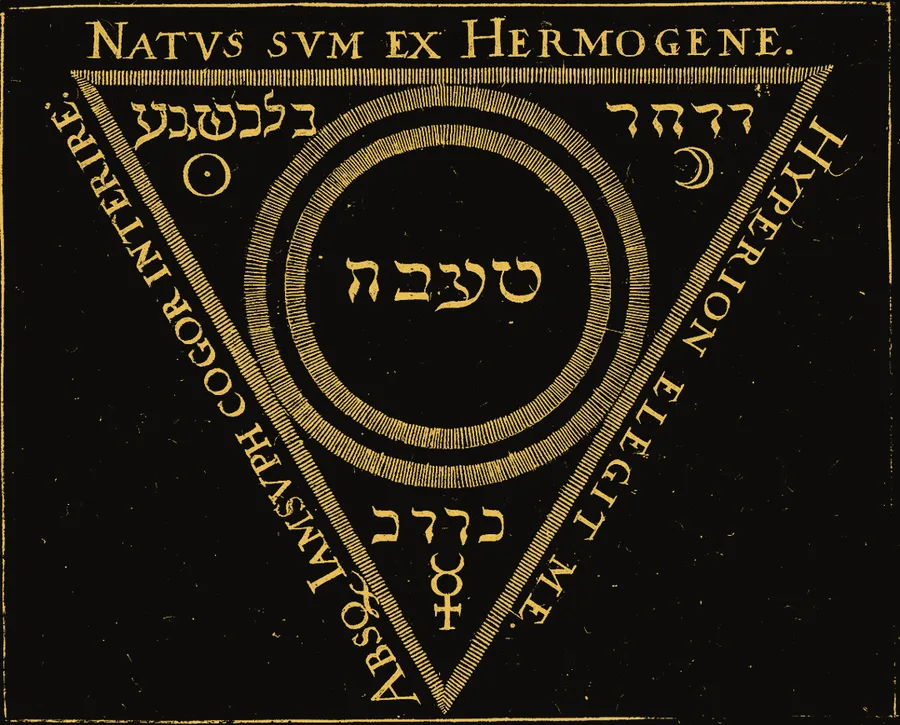
The Tenth Key is about patience. The Stone holds every quality of the world, Basil says, but only a gentle, steady fire brings them to ripeness: ‘No fruit can grow from a flower that has been plucked before the time.’ He who is in too great a hurry spoils what he has in hand.
What the engraving shows
Basil Valentine’s Tenth Key, from the Musaeum Hermeticum. Photograph: Wellcome Collection, CC BY 4.0; colours added.
The engraving is a triangle edged with three Latin sayings: Natus sum ex Hermogene (I was born of Hermogenes), Hyperion elegit me (Hyperion chose me) and Absq. Iamsuph cogor interire (without Iamsuph I must perish). Inside it a double circle surrounds Hebrew letters, with the signs of the Sun, the Moon and Mercury at its corners.
What it teaches
The Tenth Key: patience. “No fruit can grow from a flower that has been plucked before the time.” He who is in too great a hurry spoils what he has in hand.
The degrees of the fire
Basil names the old degrees of heat, the water bath called the Bath of St. Mary, horse dung, ashes and sand, and explains that they measure the fire; the work does not happen in them. Their alchemical symbols.
The Tenth Key, in full
In our Stone, as composed by me and by those who have long preceded me, are contained all elements, all mineral and metallic forms, and all the qualities and properties of the whole world. In it we find most powerful natural heat, by which the icy body of Saturn is gently transmuted into the best gold. It contains also a high degree of cold, which tempers the fervent heat of Venus, and coagulates the mercury, which is thereby also changed into the finest gold. All these properties slumber in the substance of our Stone, and are developed, perfected, and matured by the gentle coction of natural fire, until they have attained their highest perfection.
If the fruit of a tree be plucked before it is ripe, it is unfit for use; and if the potter fail to harden his vessels in the fire, they cannot be employed for any good purpose. In the same way you must exercise considerable patience in preparing our Elixir, if it is to become all that you wish it to become. No fruit can grow from a flower that has been plucked before the time. He who is in too great a hurry, can bring nothing to perfection, but is almost sure to spoil that which he has in hand. Remember, then, that if our Stone be not sufficiently matured, it will not be able to bring anything to maturity.
The substance is dissolved in a bath, and its parts reunited by putrefaction. In ashes it blossoms. In the form of sand all its excessive moisture is dried up. Maturity and fixity are obtained by living fire. The work does not actually take place in the Bath of St. Mary, in horse-dung, in ashes, or in sand, but the grades and regimen of the fire proceed after the degrees which are represented by these. The Stone is prepared in an empty furnace, with a threefold line of circumvallation, in a tightly closed chamber. It is subjected to continued coction, till all moisture and clouds are driven off, and the King attains to indestructible fixedness, and is no longer liable to any danger or injury, because he has become unconquerable.
Let me express my meaning in a somewhat different manner. When you have dissolved your earth with your water, dry up the water with its own inward fire. Then the air will breathe new life into the body, and you will have that which can only be regarded as that Great Stone which in a spiritual manner pervades human and metallic bodies, and is the universal and immaculate Medicine, since it drives out that which is bad, and preserves that which is good, and is the unfailing corrective of all imperfect or diseased substances. This Tincture is of a colour intermediate between red and purple, with something of a granite hue, and its specific weight is very considerable.
Whoever gains possession of this Stone, should let his whole life be an expression of his gratitude towards God in practical kindness towards his suffering brethren, that after obtaining God's greatest earthly gift, he may hereafter inherit eternal life. Praise be unto God everlastingly for this His inestimable gift.
Basil Valentine, The Twelve Keys (1599), in the English of the Hermetic Museum (1893).
In Lead to Gold
In Lead to Gold, the Tenth Key’s engraving is the plate of Gate 10, Exaltation, in the New light part of the path. The whole of the Twelve Keys is in the app’s Library, with a note in plain words on every key.
Last updated October 25, 2026.
Lead to Gold: Shadow Work, on Google Play
The alchemists’ Great Work, made into ten quiet minutes a day: twelve gates, a private journal, and a line of wisdom from the old masters. Free to download, for Android.
What does Basil Valentine’s Ninth Key mean?: Basil Valentine’s Ninth Key (1599) explained: Saturn, the key of the whole art, the colours from black to red, the planets’ procession, and the full text.
What does Basil Valentine’s Eleventh Key mean?: Basil Valentine’s Eleventh Key (1599) explained: the parable of the knight Orpheus, how the Stone was said to multiply, and the full text in English.
What is exaltation in alchemy?: Exaltation, stage 10 of the twelve stages of alchemy: raising it to its highest. What the alchemists did, and what it means for you.
What are Basil Valentine’s Twelve Keys?: The Twelve Keys of Basil Valentine (1599): who he was, the twelve engravings, and what each key teaches about the Great Work, in plain words.